《Mater. Horiz.》: Ordering-Induced Concentration Effect: A Mass Transport Boost for CO2 Electroreduction
Zequn Han,+ Mengqian Li,+ Peipei Li,+ Wenya Fan, Chengbin Zhang, Haohao Duan, Zhijie Wang, Qingxia Chen,* and Xingchen Jiao*
Electrocatalytic CO2 reduction into CO holds great promise in addressing environmental challenges and industrial needs. However, the practical implementation is hindered by the hydrogen evolution reaction (HER), which competes for electrons and reduces the selectivity of CO2 reduction reaction (CO2RR). Here, we proposed a novel strategy to enhance CO2RR selectivity using an ordered structure from a mass transport perspective for the first time. Ag nanowires (NWs) were selected as model catalysts and assembled into an ordered array. The ordered structure of Ag NWs induces an ordered micro electric field that crucially regulates the kinetic mass transports of both CO2RR and HER. This micro electric field is proposed to promote the preferential accumulation of CO2 on the catalyst surface while concurrently repelling H2O molecules. This dual action, which enriches the desired reactant and depletes the source for the competing reaction, tilts the balance in favor of CO2 reduction over HER, thereby enhancing selectivity towards CO production. Therefore, the ordered Ag NW array demonstrated highly efficient CO2 electroreduction to CO, achieving an impressive 97.3% Faradaic Efficiency (FE) of CO at a current density of 100 mA cm–2, significantly outperforming their disordered counterparts. This innovative approach not only inspires the design of structural assembly electrocatalysts from a mass transport perspective but also provides fundamental insights into the relationship between the ordering of structured catalysts and their CO2RR performance.
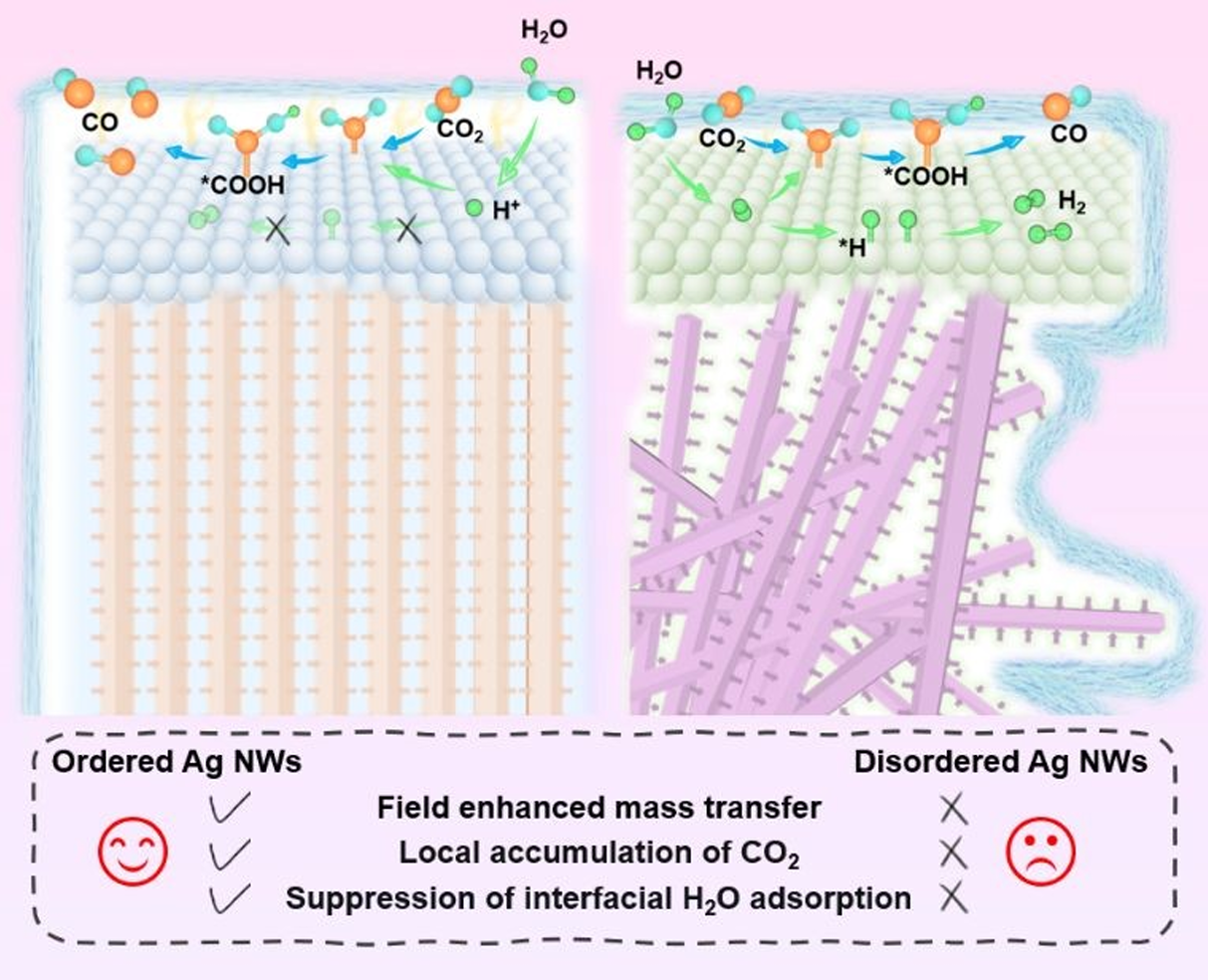
Figure 1. Schematic illustration of the optimized mass transport and enhanced selectively for CO in ordered Ag NWs in comparison with disordered counterparts.