《Sci. Bull.》: Direct photoreforming of polylactic acid waste into valuable fuels via interface-activated superoxide radicals
Dongpo He,+ Ziyao Zhou,+ Fangming Zhao,+ Zheng Li,+ Jie Xiong, Jinyu Ding, Yang Wu, Liang Chen,* Meng Zhou,* Jun Hu, Junfa Zhu, Wensheng Yan, Piming Ma,* Xingchen Jiao,* and Yi Xie
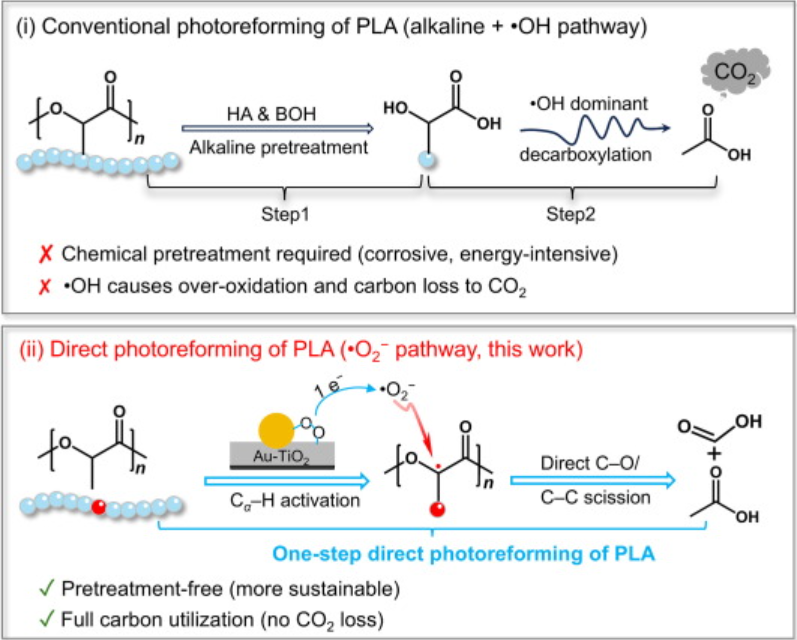
The effective photoreforming of polylactic acid (PLA) critically depends on the regulation of reactive oxygen species (ROS). Conventional pathways dominated by hydroxyl radicals suffer from short lifetimes and uncontrolled mineralization. Herein, we report the first realization of direct PLA photoreforming under ambient conditions exclusively mediated by superoxide radicals (•O2−), establishing a new pathway for selective bond scission and carbon-conserving upcycling. Such control is enabled by deliberately designed Au-TiO2 heterostructures, which form Schottky junctions and charge-transfer channels. Au serves as an electron reservoir, while TiO2 provides a robust scaffold sustaining carrier dynamics, together allowing the generation and stabilization of •O2−. Nucleophilic •O2− radicals induce Cα–H activation in PLA, which lowers the energetic disparity between C–C and C–O cleavage, thus eliminating the inherent bias toward ester cleavage and allowing C–C bond cleavage. As a result, carbon is funneled into liquid fuels, yielding acetic acid at 5.72 mmol g–1 with 71.3% liquid product selectivity, and maintaining stable activity for over one week under simulated solar irradiation. Interfacial single-electron transfer is thereby identified as a governing principle for ROS control, providing a direct and carbon-efficient route for the upcycling of PLA into liquid fuels