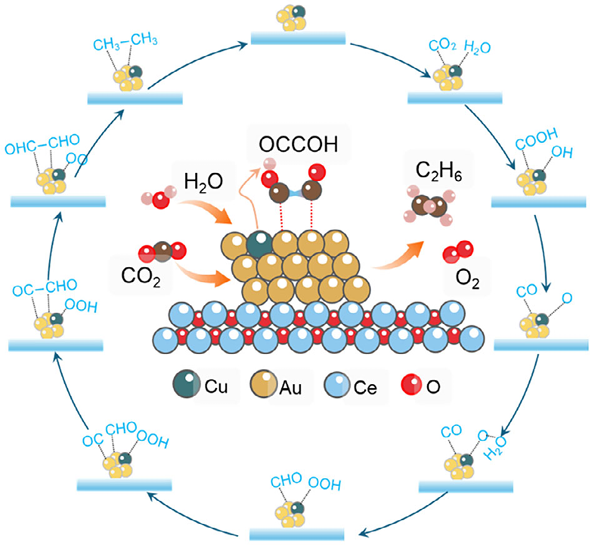
《Adv. Mater.》: Nano-Antenna Reactors With Spatially Coordinated Microenvironments Enable Atmospheric CO2 Photoreduction to C2H6
Dongpo He,+ Hangtian Hu,+ Liang Wang,+ Liang Chen, Peipei Li, Guangbing Huang, Jinyu Ding, Qinyuan Hu, Jun Hu, Junfa Zhu, Wensheng Yan, Xiaowen Ruan, Yuming Dong,* Ju Wu,* Jinguang Hu,* and Xingchen Jiao*
Photocatalytic CO2 reduction to multicarbon products is often limited by inefficient proton delivery to metal nanoparticle surfaces, restricting proton-coupled C─C coupling to a small fraction of metal-oxide interfacial sites. Here, we report a spatially coordinated microenvironment engineering strategy to activate underutilized metal surface atoms for efficient C2H6 formation, even under low CO2 concentration. An AuCu-CeO2 nano-antenna-reactor photocatalyst is constructed where CeO2 nanosheets serve as oxide antenna supports and Au nanoparticles act as CO2 reduction reactors. Notably, Cu sites incorporated within Au nanoparticles function as localized water-activation centers, creating a proton-rich microenvironment adjacent to CO2 reduction sites. In situ spectroscopy combined with density functional theory calculations reveals that this proton-rich microenvironment lowers the rate-determining *CO to *COH protonation barrier from 1.23 to 0.54 eV, promoting C─C coupling via a *CO─*COH pathway. As a result, AuCu-CeO2 achieves a ∼3-fold enhancement in C2H6 production under pure CO2 compared with Au-CeO2, while maintaining appreciable rates of 3.3 and 1.67 µmol g−1 h−1 at flue-gas (15%) and atmospheric (0.03%) CO2 levels, respectively. This work establishes a general principle for regulating proton-coupled multi-electron transformations on catalytic surfaces.