《Appl. Catal. B-Environ.》: Complete Selectivity Switching between CO and CH4 for CO2 Photoreduction on Pd-SrTiO3
Suning Zhang,+ Jinyu Ding,+ Peijin Du,+ Feng Chen, Jun Hu, Qingxia Chen, Xia Wang, Xiaodong Li, and Xingchen Jiao*
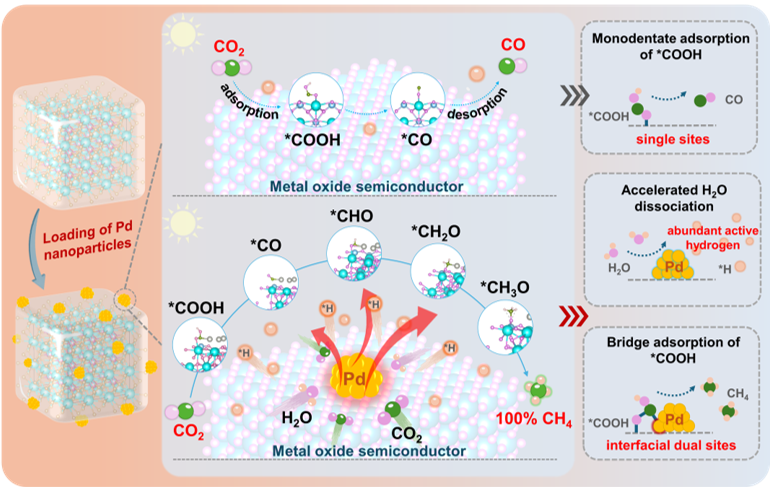
Carbon dioxide (CO2) photoreduction to methane (CH4) encounter low selectivity. This is mainly attributed to insufficient protons to sustain deep protonation; additionally, linearly adsorbed intermediates on single active sites tend to undergo direct desorption to form carbon monoxide (CO). Herein, we designed Pd nanoparticle-loaded semiconductor oxides nanocrystals, in which Pd not only facilitates water dissociation to generate protons, but also enables the construction of interfacial dual sites for bridge-mode adsorption of reaction intermediates. As a prototype, Pd nanoparticle-loaded SrTiO3 nanocrystals were synthesized. Density functional theory calculations indicate Sr–Pd hetero-sites stabilize *COOH and enhance *CO adsorption; Pd incorporation lowers the water dissociation barrier from 0.97 to 0.79 eV and facilitates sustained hydrogen spillover to generate sufficient active H species. Quasi in situ X-ray photoelectron spectroscopy and charge density difference results confirm the charge redistribution and forms electron-rich dual-active sites. Hence, the Pd-SrTiO3 nanocrystals achieved nearly 100% selectivity toward CH4, whereas the SrTiO3 nanocrystals only produced CO. This work establishes a rational principle for designing high-selectivity photocatalysts toward deep CO2 conversion into CH4.