《Nano Lett.》: Enzyme-Mimetic Tri-Site Catalyst Enables High-Performance Electrochemical Urea Synthesis
Wenya Fan,+ Changjing Wang,+ Chengbin Zhang,+ Zhuo Yang, Jiaxin Shen, Mengqian Li, Xia Wang, Xiaodong Li,* Xingchen Jiao,* and Qingxia Chen*
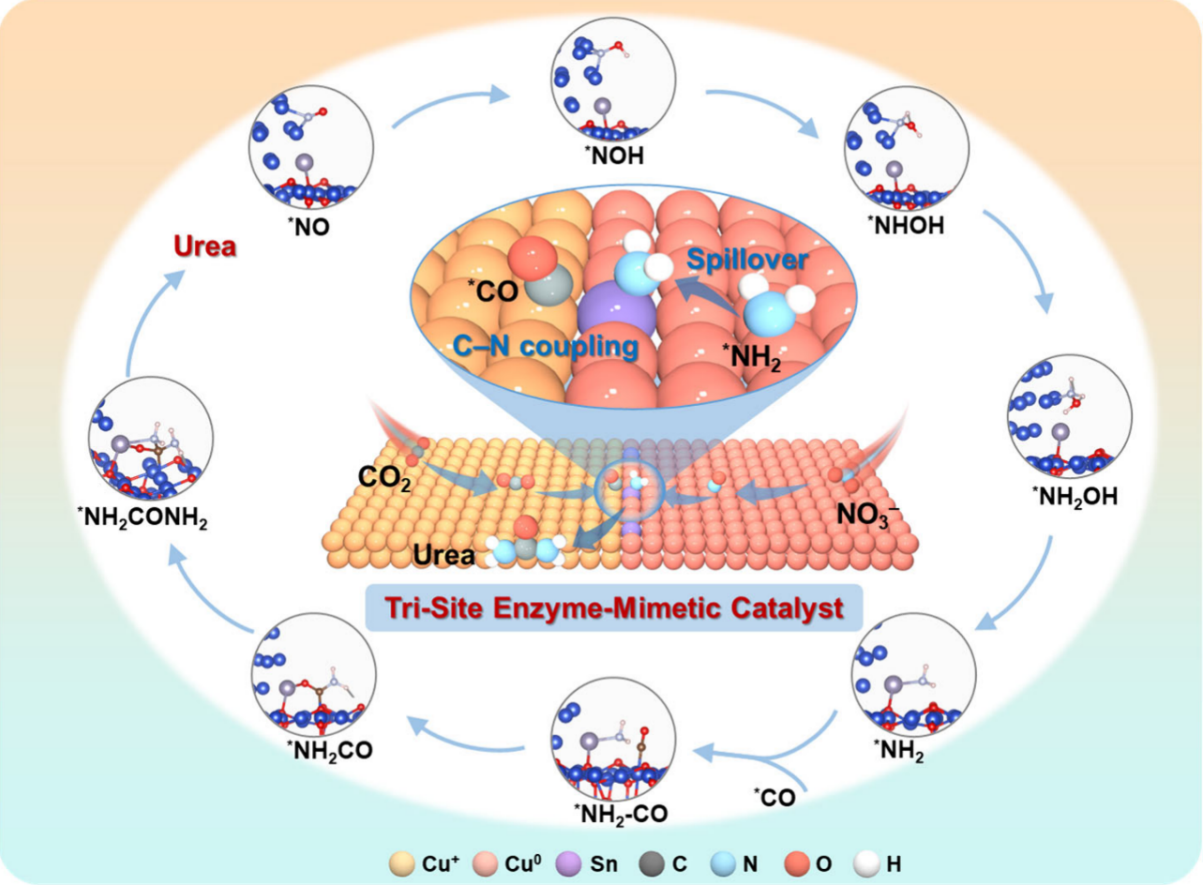
Electrochemical urea synthesis from CO2 and NO3– offers a low-energy, green alternative to the traditional Bosch–Meiser route. However, mismatched adsorption of C/N intermediates, complex proton-coupled electron transfer, and high C–N coupling barrier on conventional single- or dual-site catalysts greatly hinder catalytic efficiency. Herein, we proposed a novel, enzyme-mimetic tri-site design to spatially decouple CO2 → *CO, NO3– → *NH2, and subsequent C–N coupling. As a prototype, tri-site Sn-doped CuOx nanoparticles were constructed, where Cu1 stabilizes *CO and suppresses further protonation. Cu0 drives the stepwise reduction of NO3– to *NH2OH, which is rapidly protonated into *NH2 and spills over to Sn site. Eventually, *CO and *NH2 undergo efficient C–N coupling to form urea. Therefore, Sn/CuOx catalyst delivers a urea yield of 4824 μg h–1 mgcat–1, 26.8% Faradaic efficiency, 69.3% C-selectivity, and 30.5% N-selectivity, outperforming the bare CuOx counterpart. This work demonstrates a promising enzyme-mimetic and tandem electrocatalysis paradigm for green fertilizer synthesis.